
In Hacking the main focus is over gathering the information about victim or victim's machine. Which will help to find out which type of exploit will works according to the given circumstances. Gathering the network and host information means to find out by which network, the which victim's machine is connected and communicating over the network. Moreover, scanning is also performed for gathering information about open and closed ports. After that they'll able to find the vulnerabilities in the target system and try to get access to the system.
Types Of Scan
As a CEH you should know the scan types and uses:SYN
SYN scan doesn't complete the TCP three way handshake that is why it is known as a half-open scan. An attacker send a SYN packet to the victim machine if SYN/ACK packet is received back to attacker, then it clarify that the port is listening due to the acknowledgment by the victim that it has completed the connection. While if the attacker is received the RST/ACK packet then it assumed that the port is closed or open.
XMAS
XMAS scan works only on target system that has the RFC 793 development of TCP/IP and it doesn't works against any version of windows.XMAS scan send a packet with by setting up the FIN, URG and PSH flags of the TCP header. The function of this scan is if the port is active there will be no response but if the port is closed the target responds with a RST/ACK packet.

FIN
A FIN scan send a packet by setting up only the FIN flag of the TCP. This scan is similar to XMAS scan. FIN scan receives no response if the port is active while if the port is closed it receives the RST/ACK packet.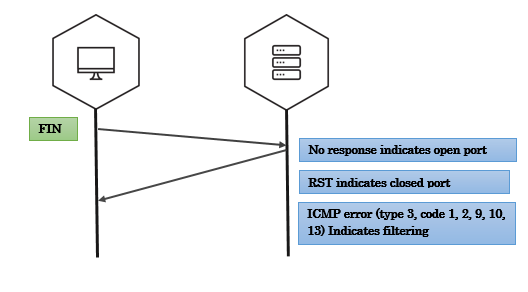
NULL
NULL scan is also similar to the XMAS scan. But the only difference is that it sends a packet without setting up the any flag of TCP header. NULL scan receives no response if the port is open but if the port is closed it receives the RST/ACK packet.
IDLE
It is just like spoofing an IP address by sending a SYN packet to the victim's machine to find out which services are available over the system. This scan is completed with the help of another system called as "Zombie" (that is not receiving or transmitting any information).
More information
- Pentest Tools For Ubuntu
- Hacker Tools Hardware
- Hack Tool Apk
- Top Pentest Tools
- Hacking Tools Mac
- Bluetooth Hacking Tools Kali
- How To Install Pentest Tools In Ubuntu
- Nsa Hack Tools Download
- Hack Tools
- Hacking Tools Pc
- Hack Tools For Pc
- Hacking App
- Nsa Hack Tools Download
- Hack Tools For Games
- Hacks And Tools
- Hacker Tools Linux
- Pentest Tools Online
- Hack Tools For Mac
- Nsa Hacker Tools
- Easy Hack Tools
- Pentest Tools Website Vulnerability
- Hacking Tools And Software
- Hack Tools For Ubuntu
- Hacker Tools Github
- Top Pentest Tools
- Hack Tools For Mac
- Hack Tools For Ubuntu
- Hacker Tools For Mac
Commentaires
Enregistrer un commentaire