
Investing is a journey fraught with highs and lows, where even the savviest investors stumble. Yet, the difference between success and failure often lies in how we manage our portfolios and mindset. Over years of navigating markets — particularly the volatile world of cryptocurrencies — I've distilled five key strategies that transformed my approach to investing. These aren't just tactics; they're mental frameworks that can help you minimize errors, boost confidence, and maximize returns. Whether you're a seasoned trader or a cautious beginner, these strategies will empower you to take control of your financial future.
The Power of Perspective: Reassess Your Positions
Imagine you had all your capital in stablecoins, untouched by market swings. Would you pour it all into your current investments? This simple question is a game-changer. It forces you to detach from emotional biases like FOMO (fear of missing out) and evaluate your portfolio objectively.
In the crypto market, it's easy to get swept up when a coin skyrockets. Take my experience with a project I invested in at $1, which soared to $4. I held on, dreaming it could be "the one" to make me a fortune, only selling near $8. Had I asked myself the stablecoin question earlier, I'd have realized I wouldn't bet so heavily on that project at its peak. This exercise isn't just for when prices soar — it's equally vital when markets dip. Constantly reassess your positions, as clinging to pride or sunk costs can lead to costly mistakes.
Pro Tip: Perform this mental reset weekly. It keeps your portfolio aligned with your goals, not your emotions.
Fun Fact: Behavioral finance studies show that investors often hold losing positions 50% longer than winning ones due to loss aversion, costing them significant returns (Kahneman & Tversky, 1979).
Define Your Thesis and Exit Plan
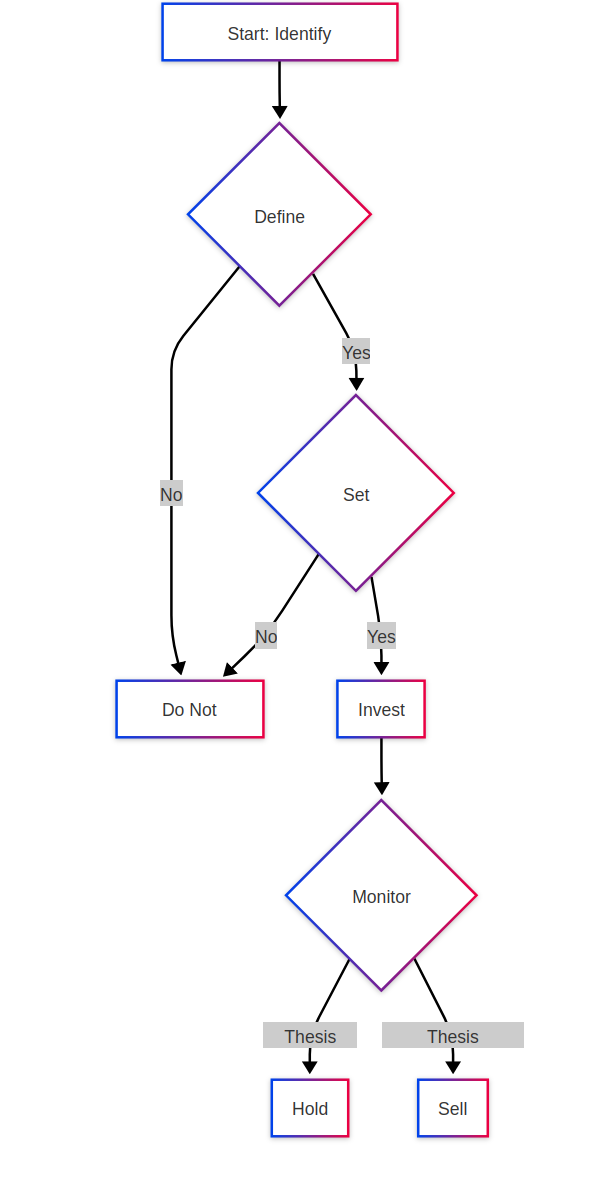
No investment should be a leap of faith. Before putting money into any project — be it stocks, crypto, or startups — establish a clear thesis (why you're investing) and an invalidation plan (when to exit). Without these, you're gambling, not investing.
Your thesis could be based on fundamentals (e.g., a company's strong revenue growth), technical analysis (e.g., a breakout pattern on a chart), or specific events (e.g., a product launch). For example, if you invest in a crypto token expecting a major partnership announcement, your invalidation might be: "If the announcement doesn't happen in two weeks, I sell." Or, if a stock drops below a key support level, like $50, that's your signal to exit.
This approach saved me from a disastrous crypto trade where I expected a token to surge after a rumored Elon Musk tweet. When the tweet didn't materialize, my predefined exit plan limited my loss to 10% instead of a potential 50% plunge.
Below is a chart to visualize the decision-making process for entering and exiting investments:
Concentrate Your Bets with Confidence
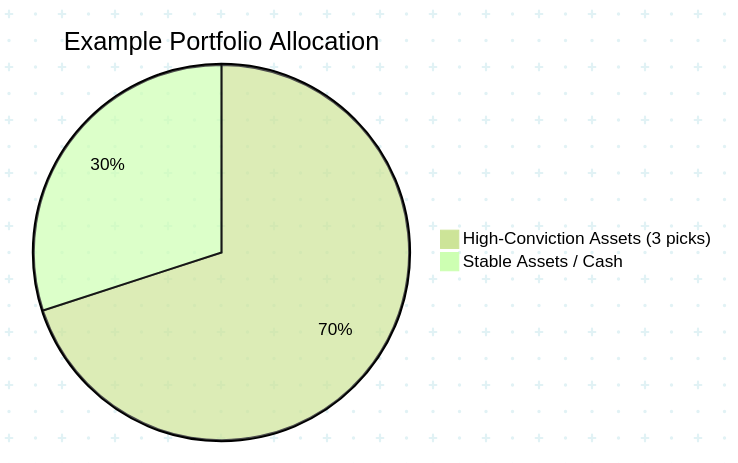
Once you've mastered crafting theses and invalidation plans, your confidence will soar. This is when you shift from scattering small bets across dozens of projects to concentrating capital in high-conviction opportunities.
In crypto, information asymmetry — where retail investors can spot opportunities before institutions — creates unique prospects. For instance, I once identified a project with a strong use case and upcoming catalyst. Instead of my usual $100 bet, I invested $1,000, knowing my thesis supported a potential 3x return with only a 10% downside risk. The trade paid off, doubling my capital. Such opportunities are rarer in traditional markets, where institutional dominance reduces retail edge.
Key Insight: Focus on 3–5 high-conviction investments rather than diversifying into 20+ low-confidence ones. Studies show concentrated portfolios outperform overly diversified ones when backed by robust research (Markowitz, 1952).
Know Your Investor Profile
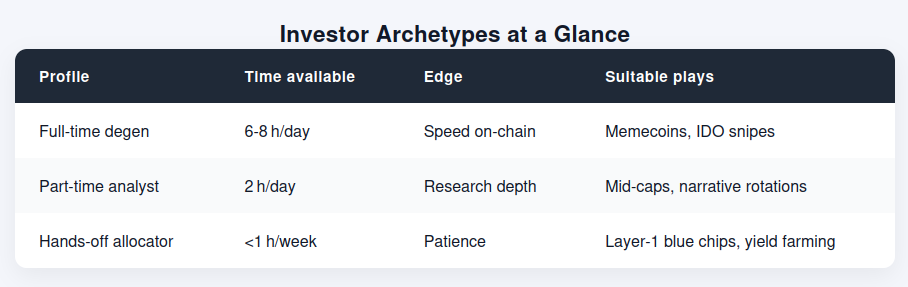
FOMO is the investor's worst enemy, luring us into trendy but unsuitable opportunities. To combat this, define your investor profile — your risk tolerance, time availability, and financial goals.
Are you a busy parent with limited time to track markets? Then chasing the latest Solana-based altcoin or day-trading meme coins isn't for you. Instead, opt for stable, long-term investments like blue-chip stocks or diversified ETFs. Conversely, if you're a young, risk-tolerant investor with hours to research, you might thrive in crypto's high-volatility environment.
I once met a father of two who lost thousands chasing a "hot" crypto token because it didn't match his risk-averse profile. Had he stuck to dividend-paying stocks, he'd have preserved his capital. Define your profile early to filter out noise and focus on opportunities that suit you.
Curious Fact: A 2021 Fidelity study found that 65% of retail investors regret impulsive trades driven by FOMO, with most citing a mismatch with their risk profile.
Embrace Market Momentum, Not Ego
You're not a market oracle, and neither am I. Predicting reversals — like calling a market top during a bull run — is a fool's errand for most. Instead, ride the wave. Markets can stay irrational longer than you can stay solvent, as John Maynard Keynes famously noted.
During the post-COVID bull run, skeptics called Bitcoin and Ethereum overvalued at $20,000 and $1,000, respectively. Yet, Bitcoin hit $69,000, and Ethereum soared past $4,800. Playing against momentum cost naysayers dearly. Focus on short-term gains, building capital while trends are in your favor.
Pro Tip: Use trailing stop-loss orders to lock in profits during uptrends without needing to time the market perfectly.
Bonus Strategy: Detach from Outcomes
Even with the best strategies, you'll make mistakes. The key is to focus on process, not results. If you've defined a thesis, set an invalidation, and managed risk, a losing trade isn't a failure — it's a learning opportunity. Analyze why you erred, refine your approach, and move on.
The goal isn't to win every trade but to ensure your wins outweigh your losses over time. As legendary investor Peter Lynch said, "In this business, if you're good, you're right six out of ten times. You're never going to be right nine out of ten."
Conclusion: Build Wealth with Discipline
Mastering your investment portfolio isn't about being a genius — it's about discipline, self-awareness, and adaptability. By reassessing positions, defining clear theses, concentrating bets, knowing your profile, riding momentum, and learning from mistakes, you'll minimize losses and amplify gains. Start applying these strategies today, and watch your confidence and capital grow.
What's your biggest investing challenge? Share in the comments below — I'd love to hear your story and offer tailored tips!
References:
- Kahneman, D., & Tversky, A. (1979). Prospect Theory: An Analysis of Decision under Risk. Econometrica.
- Markowitz, H. (1952). Portfolio Selection. The Journal of Finance.
- Fidelity Investments. (2021). Retail Investor Trends Study.
source: https://raglup.medium.com/5-proven-strategies-to-master-your-investment-portfolio-5afa5375ce15?source=rss-f56f44caad34------2
Commentaires
Enregistrer un commentaire