The Ethereum ecosystem never stops evolving. With each new proposal, the network moves closer to a more user-friendly, efficient, and secure platform. One of the latest developments capturing attention is EIP-7702, a proposal that aims to bring native account abstraction directly to Ethereum's core protocol.
Account abstraction (AA) promises to simplify how we interact with Ethereum, enabling features like more flexible key management, batched transactions, and seamless user experiences. In this article, we'll break down what account abstraction is, how accounts currently work on Ethereum, what EIP-7702 proposes, and why it could be a game-changer for everyday users.
Understanding Ethereum Accounts Today
Ethereum currently has two primary types of accounts:
1. Externally Owned Accounts (EOA):
- Controlled by a private key and public key pair.
- Commonly used by individuals (you and me).
- Creating an EOA costs no gas.
- Has a balance of ETH/tokens, a nonce for transactions, and a unique address.
- All Ethereum transactions must originate from an EOA.
2. Contract Accounts (Smart Contract Accounts):
- Controlled by deployed code (smart contracts) rather than a private key.
- Deploying a contract costs gas (since it stores code on-chain).
- Can only send transactions in response to EOAs; they cannot independently initiate a transaction.
- Have unique addresses and can be precomputed before deployment.
In simpler terms: EOAs represent users, while contract accounts represent logic defined in code. Every transaction on Ethereum begins with an EOA, limiting flexibility and user experience.
What Is Account Abstraction (AA)?
Account abstraction is the idea of transforming how user accounts function by allowing them to behave more like smart contracts. Instead of a rigid model where EOAs rely on a single private key scheme and transactions must always start there, AA introduces flexibility and programmability at the account level.
Potential benefits include:
- Batch Transactions: Combine multiple actions into a single blockchain interaction, reducing complexity and cost.
- Custom Logic for Wallets: Your account could implement tailored rules (e.g., daily withdrawal limits, social recovery, or advanced key schemes).
- Session Keys: Useful for blockchain gaming, where multiple actions can be grouped before writing to the chain, improving the gaming experience.
- Sponsor Gas Fees: Third parties could cover transaction fees for their users, enabling a smoother onboarding experience for non-crypto-savvy individuals.
- Alternative Key Schemes: Introduce passkeys or different cryptographic systems beyond Ethereum's default signature method.
In short, AA can turn a basic wallet into a customizable smart contract wallet, unlocking powerful features.
Previous AA Efforts: EIP-4337 and EIP-3074
Before EIP-7702, the community had explored AA through proposals like EIP-4337 and EIP-3074:
- EIP-4337:
Implemented account abstraction at a layer above Ethereum's core protocol (via an alternative mempool and "bundlers"). It's powerful and currently in use, but its complexity has raised concerns about security and standardization. - EIP-3074:
Another approach to delegating transaction control, but similarly complicated and not widely adopted.
While these proposals moved the ball forward, they didn't fully solve the complexity or create a unified standard. Instead, they introduced multiple paths and potential fragmentation.
Enter EIP-7702: Native Account Abstraction
EIP-7702 is a proposal by Vitalik Buterin and collaborators aiming to natively integrate account abstraction into Ethereum's core protocol. With EIP-7702:
- Your EOA can become a Smart Contract Account:
Instead of just using a private key–controlled EOA, you can choose to "upgrade" your account so it behaves like a contract account. This transformation is done through a new type of transaction, the SetCode transaction. - SetCode Transaction:
This special transaction adds a code field to your EOA's data structure. Currently, EOAs have a balance, a nonce, and an address. With EIP-7702, we add a code field, effectively embedding smart contract logic into what was once a simple EOA. - Authorization List:
The SetCode transaction includes an "authorization list" specifying parameters such as chain ID, nonce, and which contract code should govern the account. Once executed, your formerly "dumb" EOA can now act as a programmable smart contract account.
Key Advantages:
- Simplicity and Security: By integrating AA directly into Ethereum, we reduce complexity and potential security risks compared to previous proposals.
- Compatibility: EIP-7702 can coexist with EIP-4337 and other proposals. In fact, you can still use bundlers or paymasters from EIP-4337 to cover gas, making the new system flexible and comprehensive.
- Better User Experience: DApps can offer improved UX with custom transaction handling, reduced friction, and potentially gas-subsidized interactions.
Timeline and The "Pectra" Upgrade
EIP-7702 is slated for integration into Ethereum's "Pectra" upgrade, scheduled for Q1 2025. Pectra is expected to bundle multiple EIPs, and EIP-7702's inclusion will mark a significant step towards native AA.
As a result, starting in Q1 2025 (if the upgrade proceeds as planned), your Ethereum account may no longer be limited to the current EOA model. You'll have the option to transform it into a flexible, smart-contract-based entity.
Visualizing the Transition to Smart Accounts
To better understand EIP-7702, let's use a Mermaid diagram. This flowchart illustrates the process of upgrading an existing EOA to a smart contract account via the SetCode transaction:
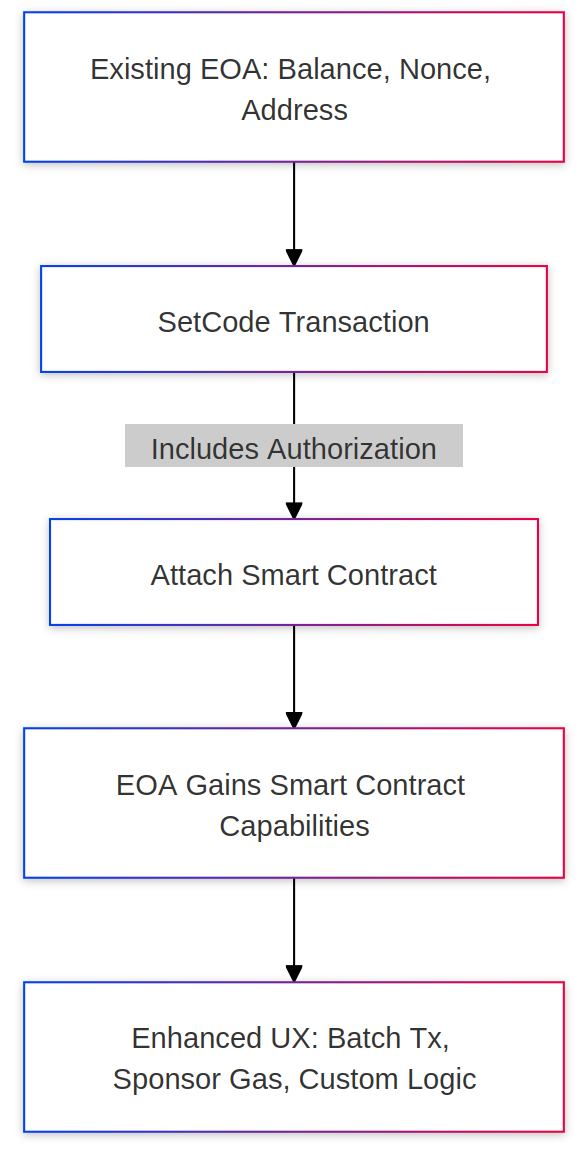
Explanation:
- We start with a normal EOA.
- A SetCode transaction is broadcast with authorization details.
- Code is attached to the EOA's storage, transforming it into a smart contract account.
- The account now can function like a contract, enabling advanced AA features.
The Road Ahead
EIP-7702 aims to standardize and streamline how we achieve account abstraction, reducing complexity and improving security. By integrating AA at the protocol level, Ethereum users can look forward to more flexible, user-friendly accounts. This approach simplifies life for developers, wallet providers, and end-users, potentially accelerating adoption and innovation in the space.
While we await Q1 2025 and the Pectra upgrade, developers and community members will continue refining EIP-7702 and other EIPs. The ultimate goal is a unified, intuitive Ethereum experience where complex key management and clunky transaction patterns become a thing of the past.
Conclusion
Ethereum's journey towards a more accessible future is well underway. With EIP-7702, the vision of native account abstraction moves from theory towards reality. This proposal can empower users with more secure, customizable, and user-friendly wallets — an essential step in bringing crypto to the next billion users.
Keep an eye on this space as Ethereum's roadmap progresses. The Pectra upgrade and EIP-7702 are just around the corner, and when they arrive, your Ethereum account might never be the same again.
Disclaimer: All timelines and proposals are subject to change based on community consensus and further technical review.
source: https://raglup.medium.com/your-ethereum-account-is-about-to-change-understanding-eip-7702-and-native-account-abstraction-9344d1c03fd2?source=rss-f56f44caad34------2
Commentaires
Enregistrer un commentaire